Headlines News :
Tampilkan postingan dengan label NOTEBOOK. Tampilkan semua postingan

Asus Zenbook Prime UX32VD


Asus Zenbook Prime UX32VD
Asus could have stopped when they made one of the best Ultrabooks on the market (twice). Last year's Zenbook UX31E was one of the best Ultrabooks on the market, despite its flaws. This summer's Zenbook Prime UX31A is once again one of our top picks, and it addressed the UX31E's flaws (keyboard, good but not stellar display). As if the 1080p IPS display on the Zenbook Prime UX31A didn't push the envelope enough, Asus has let loose the Zenbook Prime UX32VD, a near dead ringer for the UX31A but with added goodies: dedicated graphics and upgradable RAM and hard drive. Nice.

Like the UX31A, the Zenbook Prime UX32VD has an impressive 1920 x 1080 IPS display, a backlit keyboard, third generation ULV CPUs and a killer unibody aluminum design. Given the extra space required for upgradable parts and dedicated graphics, the UX32VD is a tiny bit thicker and a little heavier (3.2 pounds vs. 2.86), but it shares the same design, materials and attractive look as the UX31A as well as its 13.3" display size. In fact, so much is the same that this review will share some copy with our UX31A review.

Specs
The Asus Zenbook Prime UX32VD (who picked those final letters?) is an Ultrabook with a 13.3", 1920 x 1080 IPS display, 1.7GHz Intel Core i5 and i7 ULV CPUs (the 1.9GHz i7 is more prevalent and the i5 is more often found in the non-1080p UX32A), a 500 gig conventional hard drive with a small SSD that acts as an Intel Express Cache to speed boot and resume times, 4 gigs of DDR3 RAM and both Intel HD 4000 and Nvidia GeForce GT620M dedicated graphics. Not too shabby for $1,299. The laptop has a unibody aluminum casing that looks every bit as modern, classy and sleek as Asus' more conventional Ultrabooks. 

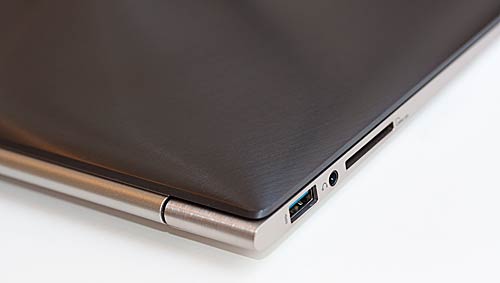
It has dual band Intel WiFi 802.11b/g/n with WiDi, Bluetooth and a 720p webcam. Notably absent is an optical drive, which you won't find on 13" Ultrabooks. The machine has three USB 3.0 ports (two on the right, one on the left), an HDMI port, mini VGA, a 3.5mm jack and an SD card slot. Asus provides a USB 10/100 Ethernet dongle and a VGA adapter.
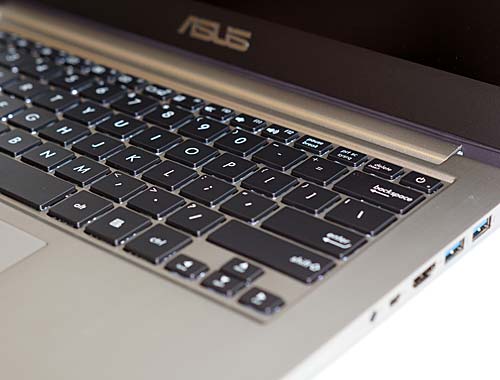
Asus Zenbook Prime UX32VD

Other Zenbook Prime Models
- The first generation Zenbook UX31E had a lower resolution, non-IPS display and Intel Sandy Bridge CPUs. It looks nearly identical to the UX31A.

- The Zenbook Prime UX31A is available with a 1.7GHz Intel Core i5 CPU (UX31A-DB51) or with a 1.9GHz Intel Core i7 CPU and a 256 gig SSD (UX31A-DB72). A classic Ultrabook by Intel's definition with SSD storage, Intel ULV CPUs and an extremely thin and light design.

- There are custom Best Buy and Amazon models as well. The Best Buy model is the same as the DB51 minus the 1 year accidental damage warranty. The Amazon AB71 has the Core i7 CPU and a 128 gig SSD.

- The Asus Zenbook Prime UX32VD has dedicated Nvidia GT620M graphics (a lower end dedicated GPU) and both the RAM and hard drive are upgradable. The UX32VD ships with a conventional spinning 500 gig hard drive and a small SSD drive that boosts boot and resume times. 

- Lastly, the Zenbook UX32A (no "Prime" in the name) is a low spec model with a 1.4GHz Core i3 ULV CPU, 320 gig conventional hard disk and a lower resolution display (not a good pick).

* The word Prime= 1080p display, an SSD drive and a backlit keyboard. 

Design and Ergonomics
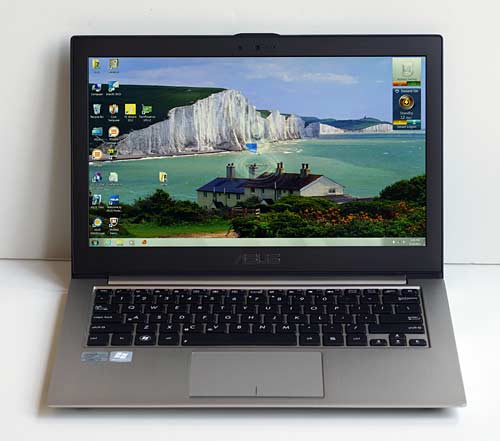
The 3.2 pound UX32VD Zenbook Prime looks almost identical to the Zenbook Prime UX31A, and that's a good thing since that machine is simply stunning looking and well made. The casing is metal and rigid, though the keyboard deck is softer and we noted some trampolining in the center that will drive serious typists a little mad. The lid and bottom panel as well as the keyboard deck are very firm in contrast. The UX32VD is just a little thicker than the 0.67" UX31A, but it's still very slim at 0.7".

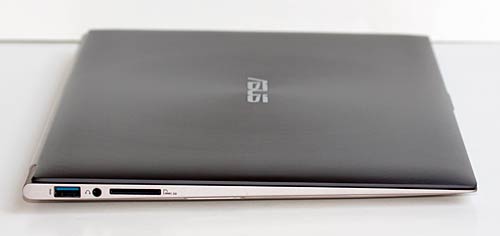
The combo of a dark metal swirl lid and a brushed stainless steel hinge barrel and bottom look great. The laptop looks and feels like a high quality piece of tech that holds its own against the MacBook Air. Like the Air, it tapers and is 5.5 mm thin at the front and 9mm at the rear. Looks are subjective, but I think the Zenbook Primes are some of the most attractive Ultrabooks on the market. The metal edges are well machined so there's no roughness or sharpness, but the front tapers to a fine point that might bother some folks' wrists.

The keyboard is much improved from Asus' first generation Ultrabooks, the UX31E and UX21E. The Chiclet style backlit keyboard has good tactile feel and travel by skinny Ultrabook standards. My only complaint is the mushy give in the center and right-of-center keyboard area. It's not a deal breaker, but it's not as good as the UX31A keyboard. 

The Elan trackpad is the same as that of the UX31A, and it's much, much better than the UX31E trackpad. However, Asus' drivers are the weakest part of the equation and I found the trackpad behaved better once I removed Asus' trackpad software and stuck with Elan's. Asus has issued a few driver updates for the trackpad, and it's now usable though not better than Elan's software.

1080p Display
The 13.3" matte 1920 x 1080 panel is simply gorgeous: very bright with lovely balanced colors and high contrast. Text is very sharp and black levels are excellent. Asus didn't skimp here. The panel is brighter than most notebooks on the market except the UX31A. The display will likely set the Zenbook Prime series ahead of the competition for some time. Since this is an IPS panel, viewing angles are very wide, and there's no need to angle the display forward and back to find the sweet spot as with TN panels. Whites are wonderfully neutral and the display looks as good as the Retina MacBook Pro. Color accuracy is much better than average for a notebook panel and it should please photo pros.

It wouldn't be an Asus product if we didn't have some light bleed, and though light bleed in IPS displays isn't uncommon, Asus seems to have more than their share. What is light bleed? The display may have lighter spots near the edges when viewing black backgrounds like the black bars in letterboxed widescreen movies. Our unit, which came from a local retailer, has a small amount of light bleed along the bottom edge, but it's nothing we'd call bad (watch our video review to see the display showing a pure black image in the dark). 

The Zenbook Prime has Intel WiFi and Intel graphics: the happy couple that's required for Intel WiDi wireless display, which is pre-installed. With WiDi and a receiver box that plugs into your home theater setup via HDMI like the Netgear Push2TV, you can stream your display's contents to your HD TV, or use your TV as a second monitor sans wires. For those who prefer wires, there's a micro HDMI 1.4 port on the right side and a 3.5mm combo headphone/mic jack. For those who use projectors and older monitors, there's a mini VGA port and Asus includes a dongle adapter that converts it to a full size VGA port. 

Performance and Horsepower
The UX32VD runs on Intel third generation Ivy Bridge ULV CPUs--no surprise there. But the Intel HD 4000 graphics plus switchable Nvidia GeForce GT620M graphics with 1 gig VRAM is news for Ultrabooks. Before you get excited, the GeForce GT620M is based on the older Fermi architecture rather than the just released Kepler architecture. What does that mean? It's not as power frugal as Kepler. And the 40nm, 64 bit GT620M used in the Asus is a low end GPU that outperforms the admittedly decent Intel HD 4000 GPU, but doesn't outperform it by a huge margin. This is an entry level dedicated GPU that will gain you 5-15 fps in 3D games but won't allow you to play the most recent 3D games like Battlefield 3 at native resolution and high settings. The machine can play current games like Diablo 3 and Skyrim at low settings and 1366 x 768 resolution with frame rates in the mid-30's to mid-40's.

The machine uses Nvidia Optimus graphics switching technology to automatically switch between integrated and dedicated graphics based on demand and the application being run, and it generally does a good job. Should you wish to override this, you can right click on an app and select the GPU you wish to use when running that app. 

Unlike most Ultrabooks whose RAM is soldered to the motherboard and thus isn't upgradable, the UX32VD has 2 gigs soldered to the motherboard and a standard SODIMM RAM slot. It ships with a 2gig DDR3 1600Mhz DIMM for a total of 4 gigs of RAM. Should you wish to remove the 11 or so Torx T5 screws that affix the bottom plate (it's not hard at all), then you can replace the DIMM and upgrade to 6 or 10 gigs of RAM using a 4 or 8 gig RAM module.

While the UX31E and UX31A use solid state drives, the Zenbook Prime UX32VD has a conventional 500 gig, 5400 RPM spinning hard drive with either a 24 or 32 gig SanDisk U100 iSSD drive soldered to the motherboard that acts as an Express Cache to speed up Windows and boot and resume times. Our model has a 32 gig SSD, but Asus lists 24 gigs as standard and some users say they've gotten the 24 gig SSD. The SSD doesn't appear under Windows disk manager or the file manager since it's used expressly as a caching drive and you can't access it directly so we're not terribly concerned about the capacity variance.

Benchmarks
PCMark Vantage
PCMarks 7386
PCMark Memories 5080
TV and Movies 3881
Gaming 10,008
Music 10,766
Communications 10,888
Productivity 8187
HDD 18,779


3DMark Vantage 4240
CPU 9117, GPU 3600
Windows Experience Index:
Processor: 7.1
RAM: 5.9
Graphics (for Aero): 6.3
Gaming Graphics: 6.3
HDD: 5.9


Benchmark Comparison Table
PCMark Vantage
Asus Zenbook Prime UX32VD 7386
Asus Zenbook Prime UX31A (Core i5) 12,272
Asus Zenbook UX31E (core i5 Sandy Bridge) 10,021
Sony Vaio T (Core i7 ULV Ivy Bridge Ultrabook) 12,120
Lenovo ThinkPad X230 (Core i5 Ivy Bridge) 8152
Lenovo ThinkPad X1 Carbon (Core i7 Ivy Bridge) 12,339
Sony Vaio S 13.3 (Core i5, NVidia GT640M LE) 7575

Battery Life
Like most Ultrabooks, the Lithium Ion polymer battery is sealed inside. The Zenbook Prime UX32VD has a beefy 48 Wh battery but the demands of a spinning hard drive and dedicated graphics take their toll. With normal productivity use (MS Office, web, email, social networking and some streaming video), the notebook lasted 4 hours and 40 minutes on a charge, which is significantly lower than the 5.7 hours we got with the Zenbook Prime UX31A.

Conclusion
The Asus Zenbook Prime UX32VD is one of the first Ultrabooks in the brave new frontier that marries typical Ultrabook specs with upgradable parts and dedicated graphics. Our advice? Wait for the second or third generation where dedicated graphics performance improves along with battery life. The NVidia GT620M doesn't offer enough graphics prowess to offset the drop in battery life and the UX32VD isn't a serious gaming machine. It's a "half way" machine that doesn't offer the power of a larger notebook nor the battery life and SSD durability of an Ultrabook. That said, if you love the look and feel of Ultrabooks and wish for a bit more graphics power and upgradable parts, the Zenbook Prime UX32VD offers that in a slim and attractive package. And the display? It's wonderful.

Related:

Price: $1,299 with Core i7, 4 gigs RAM and 500 gig HDD

Website: www.asus.com
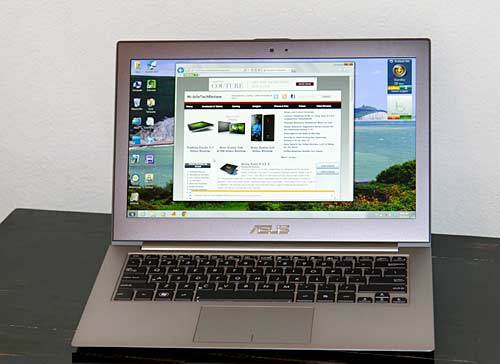
Asus Zenbook Prime UX31A

Last year's Asus Zenbook UX31E Ultrabook got top honors with reviewers and shoppers alike. It was a sleek, sexy metal notebook with higher than average resolution and strong performance. It was also one of the first Ultrabooks to hit the market, and that gave it an obvious advantage. Since then many competitors have released Ultrabooks that addressed some of the Zenbook's shortcomings. Asus is an aggressive company that listens to customers and they've not only improved on our complaints, but added a killer feature: a 1080p IPS display.

Asus Zenbook Prime UX31A

The Zenbook Prime UX31A is a 13.3" Ultrabook running on third generation Intel Ivy Bridge ULV CPUs. Asus offers it with Intel Core 1.7GHz i5 and 1.9GHz i7 dual core CPUs, Intel HD 4000 graphics, 4 gigs of RAM soldered to the motherboard and 128 or 256 gig SSDs. We take a look at the Core i5 with the 128 gig SSD for this review (model UX31A-DB51). All Zenbook Prime models have a 1080p IPS display, SSD and backlit keyboard. Yes, even the Zenbook Prime UX21A 11.6" model has a 1080p display!

Asus Zenbook Prime UX31A

Other Zenbook Prime Models
- The first generation Zenbook UX31E had a lower resolution, non-IPS display and Intel Sandy Bridge CPUs. It looks nearly identical to the UX31A.

- The Zenbook Prime UX31A is available with a 1.7GHz Intel Core i5 CPU (UX31A-DB51) or with a 1.9GHz Intel Core i7 CPU and a 256 gig SSD (UX31A-DB72). A classic Ultrabook by Intel's definition with SSD storage, Intel ULV CPUs and an extremely thin and light design.

- There are custom Best Buy and Amazon models as well. The Best Buy model is the same as the DB51 minus the 1 year accidental damage warranty. The Amazon AB71 has the Core i7 CPU and a 128 gig SSD.

- The Asus Zenbook Prime UX32VD has dedicated NVidia GT620M graphics (a lower end dedicated GPU) and both the RAM and hard drive are upgradable. The UX32VD ships with a conventional spinning 500 gig hard drive and a small SSD drive that boosts boot and resume times. 

- Lastly, the Zenbook UX32A (no "Prime" in the name) is a low spec model with a 1.4GHz Core i3 ULV CPU, 320 gig conventional hard disk and a lower resolution display (not a good pick).

* The word Prime= 1080p display, an SSD drive and a backlit keyboard.

Design and Ergonomics
The 2.86 pound UX31A Zenbook Prime is a dead ringer for the first gen Zenbook UX31E, and that's a good thing since that machine was simply stunning looking and well made. The casing is metal and extremely rigid. The combo of a dark metal swirl lid and a brushed stainless steel hinge barrel and bottom look great. The laptop looks and feels like a high quality piece of tech that holds its own against the MacBook Air. Like the Air, it tapers and is 3mm thin at the front and 9mm at the rear.

Asus Zenbook Prime UX31A

The Zenbook Prime has two USB 3.0 ports (one charging), micro HDMI, mini VGA, 3.5mm audio and an SD card slot (SD cards stick out and aren't flush with the casing). Like the last Zenbook, Asus includes a USB Ethernet adapter and VGA adapter in the box and a brown ballistic nylon slip case for the dongles and another for the laptop. 

Asus Zenbook Prime UX31A

Stereo speakers fire from the left and right edges just underneath the notebook, and volume is decent for a small machine. The tiny speaker grilles aren't positioned directly over the oval drivers inside, and I'd bet that reduces potential volume. The UX31A won't win in a battle with HP's Beats Audio notebooks, but sound is full enough that you can enjoy a few music tracks or a movie without running for the headphones or external speakers. Like the previous generation Asus Ultrabook, the UX31A has Bang & Olfusen ICEpower audio.

Despite the all metal casing, the Asus doesn't get terribly hot when doing productivity tasks. Case temps stay in the low to mi -90's Fahrenheit and the palm rest area is typically 90 degrees. When doing productivity work the fan is nearly silent, and when gaming the fan becomes audible but it doesn't roar. CPU temps are in the upper 20's Centigrade when web browsing and using MS Office (that's quite cool).

Keyboard and Trackpad
Asus has greatly improved the keyboard with much better tactile feel and key travel. Really. I spend lots of time writing and the original Zenbook keyboard annoyed me more each week. I've written 5 reviews on the Zenbook Prime keyboard and it has me smiling. It's not as tactilely delightful as the Dell XPS 13 and Lenovo ThinkPad X230 keyboards, but my typing speeds and error rates were good. The keys are backlit and you can control backlight level via Fn keys or let the ambient light sensor handle it for you. Thanks to the rigid casing, there's virtually no keyboard flex, unlike the UX32VD.

The Elan trackpad is improved as well, with more reliable tracking and multi-touch behavior, but palm rejection is weak. I installed the free utility TouchFreeze to improve palm rejection when typing. Pro tip: uninstall Asus Virtual Touch and multi-touch gestures will work much better! After Asus Live Update installed an update for Asus Smart Gesture (Asus' TouchPad driver that replaces the Elan driver), multi-touch gestures were more reliable and native palm rejection improved greatly so I didn't need TouchFreeze. Bottom line: the trackpad works, but like many Windows laptops, it falls far short of the Retina MacBook Pro and MacBook Air experience.

1080p Display

The Zenbook Prime impresses before you open the lid thanks to the elegant industrial design and sturdy feel. Open it up and the matte 1920 x 1080 IPS display seals the deal. The matte panel is simply gorgeous: very bright, lovely balanced colors and high contrast. Text is very sharp and black levels are excellent. Asus didn't skimp here. The 360 nit panel is brighter than most notebooks on the market (disable the ambient light sensor if you really want to blast your retinas). The display will likely set the Zenbook Prime ahead of the competition for some time. Since this is an IPS panel, viewing angles are very wide, and there's no need to angle the display forward and back to find the sweet spot as with TN panels. Whites are wonderfully neutral and the display looks as good as my MacBook Pro with Retina display, though Mac OS X does a better job of fine tuning fonts in Retina-aware apps. Contrast is likewise excellent with rich blacks that don't invert or look muddy.

It wouldn't be an Asus product if we didn't have some light bleed, but to be fair, light bleed in IPS displays isn't uncommon. What is light bleed? The display may have lighter spots near the edges when viewing black backgrounds like the black bars in letterboxed widescreen movies. Our unit, which came from a local retailer, has a small amount of light bleed along the bottom edge, but it's nothing we'd call annoying (watch our video review to see the display showing a pure black image in the dark). Anecdotally, the Zenbook Prime UX32VD seems more prone to light bleed according to user forums. Interestingly, our UX31A's light bleed decreased after a few days, to the point where it became hard to demonstrate for our video review. Perhaps the glue securing the display panel had finally set?

The Zenbook Prime has Intel WiFi and Intel graphics: the happy couple that's required for Intel WiDi wireless display, which is pre-installed. With WiDi and a receiver box that plugs into your home theater setup via HDMI like the Netgear Push2TV, you can stream your display's contents to your HD TV, or use your TV as a second monitor sans wires. For those who prefer wires, there's a micro HDMI 1.4 port on the right side and a 3.5mm combo headphone/mic jack. For those who use projectors and older monitors, there's a mini VGA port and Asus includes a dongle adapter that converts it to a full size VGA port. 


This is a classic Ultrabook, and that means dual core 17 watt Intel Core i5 and i7 ULV (ultra low voltage CPUs) that use less power and generate less heat than their full mobile counterparts used in standard size notebooks. That said, they're more than fast enough for everyday productivity work like web, email, MS Office and even moderate Photoshop work. 

Streaming and local HD video playback work wonderfully and that's much appreciated given the 1080p display. Ultrabooks rely on Intel HD graphics, and in the case of this third generation Intel machine, that means Intel HD 4000 graphics, which is significantly faster than the Intel HD 3000 used in Sandy Bridge models like the UX31E. That doesn't mean you can play Crysis 2 on high settings at native resolution, but casual and older 3D games play with good frame rates and even demanding current games like Skyrim play at 30 fps on low settings and a less stressful 1366 x 768 resolution. Beyond serious gaming, what else wouldn't I use an Ultrabook for? Editing 1080p video on a daily basis. It's fine in both Core i5 and i7 dual core renditions for occasional vacation footage editing, but is too slow for those who edit HD video professionally/frequently. There is no quad core i7 ULV CPU, Intel stops at dual cores.

The machine has 4 gigs of DDR3 1600MHz RAM soldered to the motherboard, so no upgrades are possible. Look to the Asus Zenbook Prime UX32VD for upgradable memory and hard drives. The Zenbook Prime UX31A is available with 128 and 256 gig SATA III SSD drives, and these are made by ADATA and Sandisk. There's no way of knowing which you'll get, since the "Sandforce" sticker that indicates the faster ADATA drive is on the inner box (the same was true with last year's UX31E). That said, the Sandisk drive is much improved over that used in the UX31E, and it no longer means a huge performance drop vs. the ADATA with a Sandforce controller. Our model from a local Microcenter had the ADATA 128 gig drive and the 1.7GHz Intel Core i5-3317U CPU.

Thanks in large part to the SSD drive, our Zenbook Prime UX31A feels very peppy, and Windows boots in well under 30 seconds. Resume from sleep takes just seconds. It scores very high on synthetic benchmarks like PCMark Vantage because of the SSD drive that's so much faster than conventional spinning hard drives, but don't let that fool you: in terms of raw processing power it's not faster than 15.6" and larger laptops with full Intel Core i5 and i7 CPUs. Though we fault PCMark for favoring SSDs so much, it does reflect the perceived performance boost they offer for core functions like launching apps and booting Windows. The machine boots and launches applications much more quickly than a quad core i7 HP Envy or Dell XPS with a conventional spinning hard drive.

Benchmarks
3D Mark Vantage: 2801 (GPU 2310, CPU 7663) on Performance test preset

PCMark Vantage: 12,272  Memories: 7336
TV and Movies: 4625
Gaming: 8920
Music: 13,620
Communications: 12,348
Productivity: 15,158
HDD: 46,609


Windows Experience Index:
Processor: 6.9
RAM: 5.9
Graphics (for Aero): 5.9
Gaming Graphics: 6.4
HDD: 7.9


Benchmark Comparison Table

PCMark Vantage
Asus Zenbook Prime UX31A (Core i5) 12,272
Asus Zenbook UX31E (core i5 Sandy Bridge) 10,021
Sony Vaio T (Core i7 ULV Ivy Bridge Ultrabook) 12,120
Lenovo ThinkPad X230 (Core i5 Ivy Bridge) 8152
Sony Vaio S 13.3 (Core i5, NVidia GT640M LE) 7575
MacBook Pro with Retina (Core i5, NVidia GT650M) 19,174

Battery Life and Networking
The Zenbook Prime UX31A has a 50 watt Lithium Ion battery that's sealed inside. Like the last Zenbook, it comes with a small charger that looks like a gloss black version of the Macbook Air charger. In our tests with WiFi active and display brightness set to 40% (which is quite bright), the UX31A averaged 6 hours on a charge, which is average for an Ultrabook and good considering the machine is pushing extra pixels.

Asus offers 4 custom power plans for performance, entertainment, quiet office and low power consumption. You can tweak these if you like, and we suggest changing the default power management for WiFi: it sets the radio to low power mode, which destroys transfer speeds. A little too power-frugal, Asus!

The UX31A has dual band Intel Advanced-N 6235 WiFi 802.11b/g/n, and range and speeds comparable to other notebooks once we adjusted that darned WiFi power setting. The metal casing didn't cause any problems with download speeds or range. The laptop has Bluetooth 4.0 as well, and 10/100 Ethernet via the included USB Ethernet adapter.


Conclusion
Do we like the Asus Zenbook Prime UX31A? Oh yes, in fact we love it. It has superb build quality, one of the most elegant and attractive designs on the market and that 1080p IPS display will spoil you. The MacBook Air's display will be a let down, and even the super color-accurate Sony Vaio Z 1080p display will seem weak for viewing angles and brightness. The much more typing-friendly backlit keyboard, fast performance and dual USB 3.0 ports seal the deal.

Price: Starting at $1,099 for the Core i5 with 128 gig SSD

Website: www.asus.com

Notebook Acer 4253

Notebook Acer 4253 Review
 Notebook Acer 4253 Review is a notebook that are due to the students. Because Acer 4253 Notebook Review specially designed to match with the student. As the price of cheap money in accordance with the students and also in special design to make it look as attractive as possible and looks really cool for students. Therefore, the manufacturer of Acer 4253 Notebook Review was launched this notebook in the student city of Jogjakarta. Because there is a lot of colleges and schools also qualified. Are you a student? You are very interested in it? This is a notebook that is recommended for students.
Notebook Acer 4253 Specifications
Notebook Acer 4253 specification have complete and attractive features such as pre-installed Windows Seven and one that is interesting is to use the AMD Fusion Dual Core processor. Notebook Acer 4253 specification also has advanced facilities like display 14-inch HD Acer Cine Crystal LED Backlite, web camera with microphone, Dolby surround sound system, Bluetooth v 3.0, 802.11a/b/g/n Wi-Fi, Gigabit Ethernet. And this is enough for the pelaja who have a high desire to learn 
Notebook Acer 4253 Full Specifications
  • 1.      Gigabit Ethernet
  • 2.      320GB SATA HDD
  • 3.      4GB RAM, & DVD Writer
  • 4.      HDMI, RJ-45, port VGA
  • 5.      Pre-installed Windows 7 OS
  • 6.      Web camera with microfon
  • 7.      Dolby surround sound system
  • 8.      include 6 Cell Li-Ion battery
  • 9.      Support DirectX 11 Grafic card
  • 10.  Multiformat card reader
  • 11.  Stereo speaker, multitouch trackpad
  • 12.  Powered by dual processor AMD Fusion Core
  • 13.  14-inch HD Acer Cine Crystal LED backlit display
  • 14.  Bluetooth v 3.0 & 802.11a/b/g/n Wi-Fi
  • 15.  4400 mAh 6-sel battery stand by until 3 hour 20 minutes.
  • 16.  Three color choice Mesh red, Mesh Brownand black Mesh 
Notebook Acer 4253 price
Notebook Acer 4253 price is Us $ 422.57 I am sure with this price you will not regret having this notebook. So do not delay to buy it immediately.

source

Sony Vaio S 13.3,Sony's on a roll with their 2012 Ivy Bridge notebooks.

Sony's on a roll with their 2012 Ivy Bridge notebooks. The Vaio S series has always been a class leader among a small group of powerful ultraportables with dedicated graphics. 

 In fact, it harkens back to the older Vaio Z and SZ lines that put a premium on both portability and upgradability. Now the S Series has split into two lines: the Vaio S 13.3 and the Vaio S 15.5. The 15.5" model is new and replaces the Vaio F Series. The S 13.3" carries on the sub- 4 pound powerhouse tradition, and in this review we look at the Sony Vaio S 13.3 Premium, otherwise known as model SVS13A190X, or simply Vaio S13A. The S13A is close to the size and weight of Sony's first Ultrabook, the Vaio T! The S is priced similarly to the T, making the S a better deal overall.
Sony Vaio S 13.3
The premium model starts at $1,119 and you get plenty for your money:
- Full mobile Intel Core i5 and i7 CPUs (dual core, third gen)
- Switchable graphics with Intel HD 4000 graphics and 1GB DDR3 Nvidia GT640M LE (Kepler) dedicated graphics
- 1600 x 900 matte display
- Carbon fiber casing (available in black, gold and gunmetal)
- Internal DVD burner (Blu-ray is optional)
- Fingerprint scanner with TPM
- 7200 RPM hard drive (SSD is optional)
- 4 to 12 gigs of DDR3 1333MHz RAM
- Backlit keyboard
- 2 USB 3.0 ports, 1 USB 2.0 port, HDMI, VGA, Gigabit Ethernet and 3.5mm audio
- Intel WiFi 802.11n with Intel WiDi and Bluetooth 4.0 + HS

Other Vaio S 13" Models

The standard Vaio S13 weighs 3.8 pounds and is 0.95" thick. The premium, thanks to carbon fiber, weighs 3.69 pounds and is 0.90". The standard model starts at $799 with integrated graphics and the $999 enhanced model has switchable dedicated graphics. Both standard and enhanced have 1366 x 768 displays. Our premium rocks a good quality 1600 x 900 matte display with decent blacks and above average color saturation. It's not as good as the superb 1920 x 1080 panel used on the Sony Vaio Z, but that machine costs a good deal more.

In this review we cover the $1,199 premium model with 6 gigs of RAM and a 640 gig 7200 RPM hard drive. The laptop has a 4,400 mAh Lithium Ion battery and there's an optional sheet battery that doubles runtimes. If you remove the notebook's bottom cover (affixed with two small Phillips head screws) you can access the battery, single RAM slot and hard drive. The notebook has 4 gigs of RAM soldered on the motherboard and one standard SODIMM RAM slot (ours shipped with a 2 gig module but I upgraded it to an 8 gig module for a total of 12 gigs).

Is the Vaio S13A just a poor man's Vaio Z? For some it might be, but I see it as a more all-around machine for those who need an optical drive and internal dedicated graphics and can live with 3.7 vs. 2.5 pounds on the road.
Sony Vaio S 13.3
Carbon fiber goodness: the Sony Vaio Z and Sony Vaio S 13.3 Premium.

Deals and Shopping:


Sony Vaio S 13.3 Gaming Demo

In the video below we test Skyrim, Diablo III, May Payne 3 and Civ V on the Sony Vaio S 13.3 Premium with the Nvidia GT640M LE. We tested all the games at native 1600 x 900 resolution, and often used fairly aggressive quality settings (we show you the settings used for each game in the video). Results were suprisingly good with very playable frame rates (shown on screen courtesy of FRAPS). The Vaio has the 2.5GHz Core i5 and it's clearly good enough to play today's demanding 3D games.

Design and Ergonomics

The Vaio S, Vaio T and Vaio Z use Sony's "full flat" design. That's not a very compelling moniker from a marketing perspective, but it does aptly describe the thin and flat chassis design. There's no Apple taper and Sony goes with an angular look rather than gentle curves. The Vaio S is attractive and looks like a quality piece. The mirrored angular hinge is a unique design touch with practical applications: it blocks the rear vents less than standard lid designs and allows for a cleaner appearance from the sides. The angled edges look cool and make the notebook easier to grip. The usual large Vaio logo graces the lid in silver on standard models and it's gold on the premium model.

The premium model has a carbon fiber casing like the Vaio Z and other high end Sony notebooks of the past. Carbon fiber isn't just designer frou frou: it's lighter, thinner and strong. That's how Sony achieves the thickness and weight reduction, and it looks good too. The standard Vaio S 13.3 has a magnesium alloy casing that's also strong but in terms of aesthetics, it somehow looks and feels like plastic (likely because the painted alloy is so thin and light). I prefer the carbon fiber look, but functionally, both the magnesium and carbon fiber models are good stuff. The display panel exhibits Sony's usual flex, which they say is intentional so the display bends without snapping. I've been using Sony notebooks for years with these thin and flexible display panels and have never had a problem with them.
All ports are on the right, so there's no need to hunt for that USB or HDMI port. The notebook (regardless of variant) has 2 USB 3.0 ports, 1 USB 2.0 port, HDMI, gigabit Ethernet, VGA and a 3.5mm audio jack. That's a good set of ports for a machine this small, and the only thing we long for is a DisplayPort to drive very large, high resolution displays that exceed the HDMI port's 1920 x 1200 max resolution. The Vaio S has both SD and Memory Stick Duo slots as well.

Display and Sound

The 1600 x 900 matte display is head and shoulders above today's gloss displays for clarity thanks to the lack of reflections. It has rich colors despite the matte finish and slightly better than average color gamut (compared to the notebook average). Why is a matte display a premium feature on notebooks? Because manufacturers can use cheaper, less capable panels that rely on the gloss finish to increase apparent contrast, black levels and color depth.

Viewing angles are again a bit better than most notebooks with TN panels, and that means the sweet spot for best viewing isn't as hard to find compared to other laptops with TN panels (most notebooks use TN panels, inlcuding Vaio S 13.3 models). Viewing angles aren't nearly as good as IPS displays by any means. Is the premium display as good as the Sony Vaio Z's 1920 x 1080 display? No. You do get what you pay for. The Z has an unusually wide color gamut, and colors and highlights really pop compared to the S premium. In terms of sharpness, the Vaio S13A has high pixel density so text and images look very sharp. The Vaio S 13.3 premium has a good display, but we'd love to see an even better one to compete with Apple's non-Retina notebooks and the Asus Zenbook Prime UX31A Ultrabook. After all, it is a premium notebook.

The machine has Intel WiDi wireless display courtesy of Intel HD 4000 graphics and the Intel Advanced-N 6235 single band WiFi card. That means you can output a movie and anything else you wish to your TV wirelessly if you have a WiDi wireless receiver like the Netgear Push2TV attached to your home theater system via HDMI.

Sony's stereo speakers are by no means impressive. It never ceases to amaze us that a company that's known for excellent consumer and pro audio gear can ship such tinny notebook speakers. Despite help from both Dolby Mobile Home Theater v4 software and Sony's own xLoud/Clear Phase audio enhancements, the speakers aren't very loud and they have no bass. You can choose between Sony and Dolby audio, and Dolby is much louder and a bit more full. Connect headphones or stereo speakers and you'll hear a world of difference: lush sound with good bass and plenty of volume. The audio circuitry and software are good stuff; it's the speakers that hold the system back.

Keyboard and Trackpad

We're quite fond of Sony's roomy chiclet keyboards: they have plenty of key spacing and the keys are relatively large. The Vaio S has good key travel (much more than the 0.66" thin Vaio Z or the Vaio T Ultrabook) and good tactile feel. The keyboard doesn't offer the Lenovo ThinkPad's dreamy tactile feedback, but somehow I type just as fast on the Sony as on the Lenovo ThinkPad X230 12.5" notebook. The premium model has a white backlit keyboard and the light shines out from the keys' edges. When plugged in, the backlight stays on all the time in dim environments. When unplugged, the backlight turns on when you press a key, and it turns off after a short period to save power (you can set the interval but it's fairly conservative).

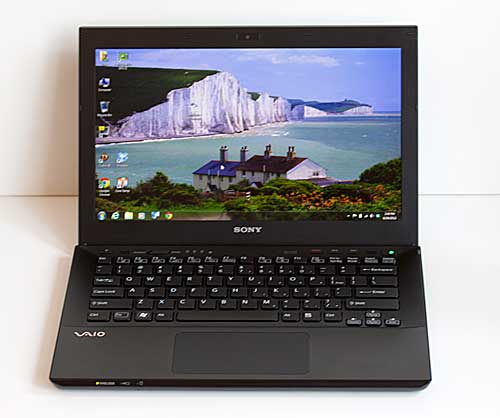
The Vaio has Sony's usual dedicated shortcut keys above the keyboard for Vaio Care, web browser and the application of your choice. There's a dedicated CD eject button at the upper left corner, and caps lock indicators to the right. The charging, wireless and HDD LEDs live on the front edge. The power button is at the right corner and it illuminates in green when the machine is turned on.

The Synaptics buttonless touchpad is huge for a 13" notebook. It supports multi-touch gestures and it's more reliable than most other brands of Windows notebooks. The surface is ever so slightly rougher than the keyboard deck so you can tell if you've wandered off the trackpad. Though it lacks buttons, it clicks when you press the trackpad, and you can use the usual left and right click functions.

Horsepower and Performance

Here's the thing: Ultrabooks are all the rage right now, and there's a lot to like about them: they're super light, slim, have quality casings and reasonable processing power. But Sony was in the business of making ultraportable computers long before the netbook and Ultrabook crazes hit the market. They make machines with standard laptop computer processing power that fit in a near-Ultrabook size case. And the Vaio S (standard or premium) offers full mobile third generation Intel Core i5 and i7 dual core CPUs that run circles around the ULV (ultra low voltage) CPUs used in Ultrabooks. Do you need all that processing power? If you just use MS Office, email, web, occasionally edit photos, play music and watch video then you don't. But if you often use heavyweight apps like Adobe Creative Suite, edit 1080p video frequently and play today's demanding 3D games then you do need a full mobile CPU and likely a dedicated GPU for 3D gaming.

The base Sony Vaio 13.3 ships with 5400 RPM drives and the premium model ships with 7200 RPM hard drives. If you built to order on Sony's website, you can get SSD drives in 128, 256 and 512 gig capacities. 

These are the same RAID 0 drives used in the Sony Vaio Z, but they use a standard SATA II/III connector. Since you can easily access the hard drive bay, that means you can upgrade to an SSD drive later to save money if you wish. Sony achieves extremely high data transfer speeds with their RAID 0 SSDs though, that surpass even the fastest aftermarket SSD drives like the Samsung PM830. SSD drives improve speed immensely when launching apps and booting Windows, though the Vaio S with a conventional HDD boots faster than average and wakes from sleep in just 2 seconds thanks to Rapid Wake technology.

The notebook has 4 gigs of DDR3 RAM soldered to the motherboard and one standard SODIMM RAM slot that accepts modules up to 8 gigs (the largest currently available in notebook SODIMM size). The machine uses 1.35 and 1.5v 1333MHz RAM. I installed a 1.5v 8 gig Corsair ValueSelect DIMM and it works perfectly.

Benchmarks

Synthetic benchmarks like PCMark Vantage give lots of points to fast SSD drives, and that's why the Vaio S 13.3 (and other powerful and larger notebooks) score lower on synthetic benchmarks than slower Ultrabooks with SSD drives.
3D Mark Vantage: 5611 (GPU 5032, CPU 8565) on Performance test preset
PCMark Vantage: 7575
Memories: 5014
TV and Movies: 3625
Gaming: 5957
Music: 6594
Communications: 9633
Productivity: 6321
HDD: 4219

Windows Experience Index:
Processor: 7.1
RAM: 7.4
Graphics (for Aero): 5.9
Gaming Graphics: 6.8
HDD: 5.9


Benchmark Comparison Table
   Sony Vaio S 13.3 Core i5, NVidia GT640M LE Sony Vaio Z 2012 Core i7 Lenovo ThinkPad X230 Core i5 Sony Vaio T Core i7 ULV Ultrabook MacBook Pro with RetinaCore i5, NVidia GT650M
PCMark Vantage 7575 17,003 8152 12,120 19,174
3DMark Vantage 5611 4,003 3209 3,078 10,656

Intel HD 4000 Graphics and NVidia GT640M LE Dedicated Graphics

All but the base $799 Vaio S13.3 offer switchable graphics with the new Intel HD 4000 integrated graphics processor and NVidia GeForce GT640M LE graphics with 1 gig of DDR3 VRAM. The HD 4000 is by far Intel's most capable integrated graphics chipset yet, and the NVidia GPU is built on a 28nm architecture with 3 to 4x the performance per watt of the outgoing 40nm Fermi architecture.

Dedicated graphics are extremely scarce in 13.3" Ultrabooks and they allow for things like faster video editing, faster Photoshop work and 3D gaming at solid frame rates. Our Vaio S13A with the base 2.5GHz Intel Core i5- 3210M with Turbo Boost to 3.1 GHz running on dedicated graphics had no trouble playing Diablo III, Skyrim and Max Payne 3 at native 1600 x 900 resolution with quality set to medium. Diablo 3 played at 45-70 fps depending on the screen, and Max Payne 3 (medium settings) ranged from 45 to 60 fps. 

That's very impressive gaming performance that we'd expect to see on a 15"+ laptop rather than a lightweight 13.3" model with an upper mid-range mobile GPU. Nice. The 2.9GHz dual core i7-3520M would boost frame rates a bit, but we found it wasn't necessary with today's demanding 3D titles. Sony currently does not offer a quad core i7 option on the S 13.3.

Sony has employed a hardware "Speed/Stamina" switch for graphics switching for years and we love it. It's much more reliable than software switching used by AMD for Radeon graphics cards and even NVidia Optimus switching. There's no need to reboot when switching modes and it's extremely quick. One thing to note: even when on the Speed setting, the notebook will sometimes drop down to Intel HD 4000 graphics when the machine is set to the default Balanced setting in Sony power management. This is particularly annoying when you're in the middle of a battle in a game! Use the Vaio Control Center to set the fan to "Priority to ventilation" for the Speed setting and the problem goes away. Happily, the fan doesn't get much more aggressive on the Priority to ventilation setting.

Heat and Fan Noise

When fast components are jammed into a small chassis, heat can be an issue, but NVidia's new 28nm Kepler architecture generates noticeably less heat. The same is true of Intel's third generation 22nm Ivy Bridge CPUs: they run a bit faster and are cooler chips. Surprisingly, we noted that the Intel HD 4000 GPU doesn't run cooler than the chilly GT640M LE. Unlike aluminum, carbon fiber and even magnesium alloy don't transfer heat as directly to your skin, so the laptop never feels unbearably hot, even when gaming. Our machine's bottom stayed at a tolerable 93-99F except at the rear exhaust vent that reached 103F when playing games like Max Payne 3. The keyboard area doesn't get hot, and the far right wrist rest area gets warm (the hard drive is under there).

Fan noise is greatly improved in both the Vaio S and Vaio Z. Fan noise is even and not whining or grating. It's fairly quiet when doing productivity tasks. When playing 3D games (with either integrated or dedicated GPU) and exporting 1080p video, the fan cycles on and off and is certainly audible but it doesn't roar. When we set Sony's power management to priority cooling under speed (dedicated graphics) mode, the fan stays on more of the time but still doesn't get crazy loud. In fact, it's often a little quieter since it keeps the machine running cooler.

Software

The Vaio S 13.3 is available with Windows 7 Home for the base price and you can get Windows 7 Professional for an additional charge. We particularly like the Sony premium video and sound editing titles included. You get the usual Office 2010 Starter Edition, a 30 day trial of Kaspersky Anti-Virus 2012, webcam software (including software that does PlayStation Move-like motion control for a few apps), Cyberlink Power DVD, Sony Vegas Platinum 11 (capable video editing software) and Sound Forge Audio Studio. There's a utility that lets you use the Vaio's keyboard with your PS3 and the less useful but large Play Memories Home. And there's Sony's redundant VaioGate app launcher that runs across the top of your desktop (fortunately it's easy to kill).

Battery Life

The machine has a 4,400 mAh Lithium Ion battery that lives under the bottom door. This isn't a quick swap battery that you release with a latch; rather you have to remove two screws that secure the door to access the battery. Sony sells an optional $150 4,400 Lithium Ion polymer sheet battery that attaches to the notebook's base to double runtimes.

Sony claims 7 hour runtimes, and that's obviously using integrated graphics with the display set at 50% or less. In our real world productivity tests with the brightness set to an adequate 40% and both WiFi and Bluetooth on, we averaged 6.3 hours on a charge. When playing video, the machine averaged 5.9 hours. Expect dedicated graphics to drop those runtimes by 1.5 hours or more. That's pretty darned good given the size and power of this notebook, but it's not one of the longest lasting notebooks on the market.

Conclusion

If you're looking for that narrow intersection of performance and portability, the Sony Vaio S 13.3 is hard to beat. You get the creature comforts of a big notebook (optical drive, dedicated graphics, full mobile CPUs) in a not much heavier or thicker than Ultrabook package. This laptop can do the jobs of both a capable 15" notebook and an Ultrabook. The 1600 x 900 matte display is a pleasure for long work sessions and photo editing thanks to the matte finish, and the excellent backlit keyboard is perfect for those who type lots. 

The Vaio S is extremely stylish with excellent build quality and it will likely be appealing to those of you who find the also powerful 12.5" Lenovo ThinkPad X230 too thick or dull. It also beats the X230 on resolution, though not on display quality (Lenovo's IPS display is sweet). And for you style/quality mavens who are also considering the 13" MacBook Pro, keep in mind that the Sony offers a higher resolution matte display and dedicated graphics, which the 13" Mac lacks.
Price: $1,199 as tested. Standard starts at $799, Enhanced at $999 and Premium at $1,119
Web Site: www.sony.com
 
Support : Creating Website | Johny Template | Mas Template
Copyright © 2011. GADGET ONLINE - All Rights Reserved
Template Created by Creating Website Published by Mas Template
Proudly powered by Blogger